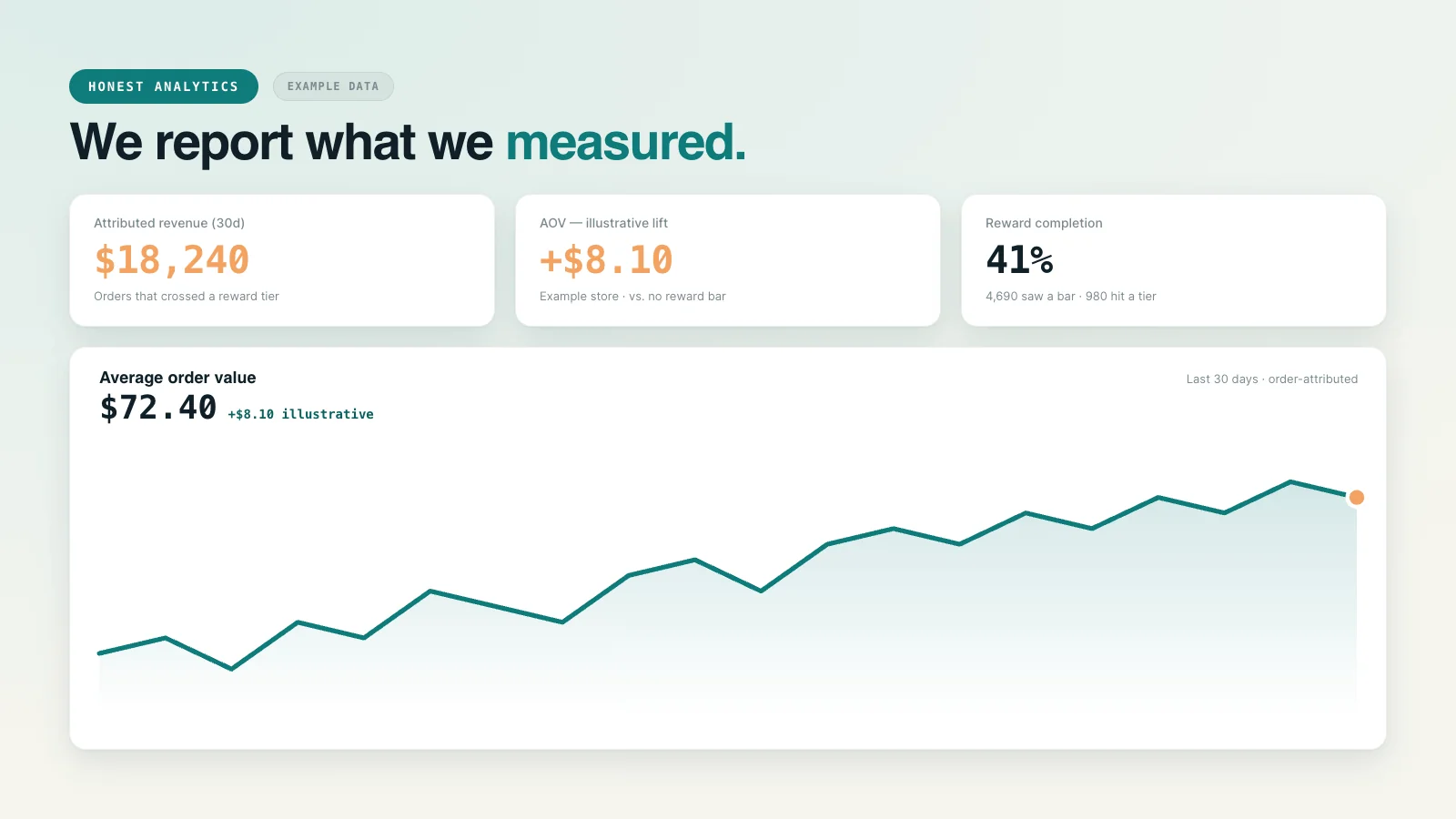
Get each existing customer to spend a little more per order and every dollar drops closer to the bottom line, because you've already paid to acquire them. This guide covers what AOV is, how to calculate it, realistic benchmarks, and eight cart tactics that actually move it on Shopify — with the maths behind each so you set them up to make money, not give margin away.
What is average order value?
Average order value is the average amount a customer spends in a single order. It's one of the three numbers that decide store revenue, alongside traffic and conversion rate.
How to calculate average order value
AOV = Total revenue ÷ Number of orders
If you did $20,000 in revenue across 400 orders last month, your AOV is $50. That's it. (Shopify shows it natively under Analytics → Reports → Average order value, so you don't have to do it by hand.)
Why AOV is the cheapest growth lever
Raising AOV is usually cheaper than raising traffic or conversion rate because:
- You've already paid to acquire the shopper. Extra spend on an order is almost pure margin — no new ad cost.
- It compounds with everything else. A 15% AOV lift flows through every order, forever, not just a one-off campaign.
- It funds your ad budget. A higher AOV means you can afford to bid more for customers than competitors with a lower one.
What's a good AOV? (benchmarks by industry)
AOV varies enormously by category, so "good" is relative to your niche, not a universal number. As rough industry ranges:
| Category | Typical AOV range |
|---|---|
| Apparel & accessories | $60–$120 |
| Beauty & cosmetics | $40–$70 |
| Home & furniture | $120–$250 |
| Food & beverage | $30–$60 |
| Jewelry & luxury | $150–$400 |
(Illustrative ranges — treat your own trailing 90-day AOV as the baseline to beat, not these figures.)
The point isn't to hit a benchmark; it's to beat your own number quarter over quarter.
8 tactics to increase average order value on Shopify
The highest-leverage tactics all live in the cart — the moment a shopper has decided to buy and is most receptive to "add a little more."
1. Set a free shipping threshold just above your AOV
Free shipping is the single most reliable AOV lever — if the threshold is set right. The rule of thumb: threshold ≈ your AOV × 1.2–1.3, rounded to a clean number. A $50 AOV store should test a $60–$65 free-shipping goal.
That sits high enough that committed buyers don't automatically qualify, but low enough that a shopper on the fence will add one more item to clear it. Aim for 50–70% of orders to reach the threshold; if fewer than 40% do, it's too high.
2. Show a reward progress bar in the cart
A threshold only works if shoppers can see it. A progress bar that says "You're $12 away from free shipping" and fills as items are added turns an invisible rule into active motivation. The cart drawer — right above the checkout button — is the highest-intent place to show it.
This is the core of what CartClimb does, and it's where most of the AOV lift comes from: making the goal visible at the exact moment of decision.
3. Stack tiered rewards (spend-and-get)
Don't stop at one goal. Cascade rewards so there's always a next milestone:
Spend $50 → free shipping · $75 → 10% off · $100 → a free gift
Each tier re-motivates the shopper who just cleared the last one. A single bar that stacks free shipping → discount → free gift is far more effective than any one reward alone.
4. Offer a free gift with purchase
A free gift at a cart threshold lifts AOV without training shoppers to expect money off. The catch most stores miss: the gift has to auto-add to the cart (shoppers won't hunt for it) and the line should be locked so they can't change its quantity. See the deep-dive: How to Add a Free Gift With Purchase on Shopify.
5. Add a cart upsell or cross-sell
A relevant suggestion in the cart — "Add the matching socks" — is one of the highest-intent upsell spots on the store. Best practice: limit it to 2–3 suggestions (more causes decision paralysis), keep each at ≤25–30% of cart value, and never hide the checkout button to make room. See: Shopify Cart Upsell: tactics that actually lift AOV.
6. Bundle complementary products
Bundles raise AOV by making "buy more" the easy default. A "complete the set" bundle at a small discount versus buying items separately nudges the basket up while still feeling like a deal to the shopper.
7. Use volume / quantity breaks
For consumable or giftable products, "buy 2, save 10% · buy 3, save 15%" moves shoppers up a quantity tier. It works best where buying more is genuinely useful (coffee, skincare, socks) rather than forced.
8. Add a post-purchase upsell
A one-click offer after checkout — before the thank-you page — adds revenue with zero risk to the original conversion, because the sale is already banked. It's "found money" on top of the order you already won.
How to measure whether it's working
Watch these in Shopify Analytics over a meaningful window (4+ weeks):
- AOV trend — the headline number.
- % of orders hitting your threshold — your tuning dial (target 50–70%).
- Cart-to-checkout rate — make sure upsells aren't adding friction that costs you conversions.
If AOV rises but conversion drops, you've over-pushed — pull back the upsell volume.
Common mistakes that kill AOV tactics
- Invisible offers. A free gift or threshold nobody sees does nothing. Visibility in the cart beats the offer itself.
- Threshold set too high. If almost nobody qualifies, it demotivates instead of motivating. Tie it to AOV × 1.2–1.3.
- Too many upsells. 5+ suggestions = decision paralysis. Show 2–3.
- Unlocked free gifts. If shoppers can bump the gift quantity, you ship freebies at a loss. Lock the gift line.
- Hiding the checkout button. Over 70% of cart activity is mobile — keep checkout always visible.
Frequently asked questions
What is a good average order value?
It depends entirely on your category — apparel might be $80, furniture $200. The only benchmark that matters is beating your own trailing-90-day AOV.
How do I calculate AOV on Shopify?
Total revenue ÷ number of orders. Shopify shows it natively under Analytics → Reports → Average order value.
What's the fastest way to increase AOV?
A free shipping threshold set ~20–30% above your current AOV, made visible with a cart progress bar. It's the highest-leverage single change for most stores.
Does increasing AOV hurt conversion rate?
It can if you over-push. Add upsells gradually and watch your cart-to-checkout rate; if it drops, reduce the number of suggestions.
Make the goal visible at the moment of decision
CartClimb is a Shopify reward bar that cascades free shipping, discounts and a self-adding free gift on one bar — exactly the visibility that moves AOV.
Explore CartClimb →